Bring back the answer.
Approved providers compute inside their own environments and return bounded evidence, not broad private-data feeds.
Corroboration
The point is not to collect more private data. The point is to ask whether source-side patterns support the applicant claim strongly enough for a lender to inspect and defend.
Boundary
A lender may need to know whether a claimed residence, work pattern, or source-side context coheres. It does not need every raw event behind that answer.
Approved providers compute inside their own environments and return bounded evidence, not broad private-data feeds.
The record shows what was checked, what boundary applied, and why the result mattered to the underwriting question.
Missing or contradictory evidence routes to review instead of disappearing inside a synthetic confidence score.
Signal landscape
Most players carry one or two of these axes and roll them into a score you cannot open. Kenshiki binds all six as inspectable evidence — what was checked, what boundary applied, what the source returned. The differentiator is the binding architecture, not exclusive data access.
| Axis | Kenshiki | SentiLink | Socure | LexisNexis Risk | Equifax · Experian · TransUnion | Plaid · MX · Finicity | The Work Number · Truv · Pinwheel | Prove · Boku · Telesign |
|---|---|---|---|---|---|---|---|---|
| Spatiotemporal presence Longitudinal location-pattern corroboration | Bound | — | — | — | — | — | — | — |
| Carrier-attested telecom SIM/number via CAMARA, consent-gated | Bound | Adjacent | Adjacent | Adjacent | — | — | — | Vendor signal |
| Life-context corroboration Household trajectory matched to the loan ask | Bound | — | — | Adjacent | — | — | — | — |
| Income at source Payroll-verified at origin | Bound | — | — | — | Adjacent | Adjacent | Vendor signal | — |
| Open-banking cash flow Real account history vs. thin or synthetic | Bound | — | — | — | Adjacent | Vendor signal | — | — |
| Identity-element trace SSN and history continuity over time | Bound | Vendor signal | Vendor signal | Vendor signal | Vendor signal | — | — | Adjacent |
As of June 2026. Based on publicly stated product capabilities. Ratings are qualitative. “Bound” means the signal is admitted into Kenshiki’s evidence record as inspectable evidence. “Vendor signal” means the player offers this as a core product capability. “Adjacent” means the player carries a related or partial capability. ”—” means this axis is not part of their stated offering at time of review.
Static map preview
The static preview compares a coherent pattern with an unsupported flat signal. It is illustrative only: no map service loads here, and no real applicant data is shown.
Green cells show a coherent source-side pattern. The isolated warning cell shows the kind of flat signal that needs review.
Residence continuity
Source-side fit
Context coherence
Recurrence
At short timescales, ordinary movement can look almost like a Lévy flight: clustered local steps interrupted by occasional long jumps. The difference appears over longer windows. Home, sleep, work, care obligations, and routine return forces beat diffusion.
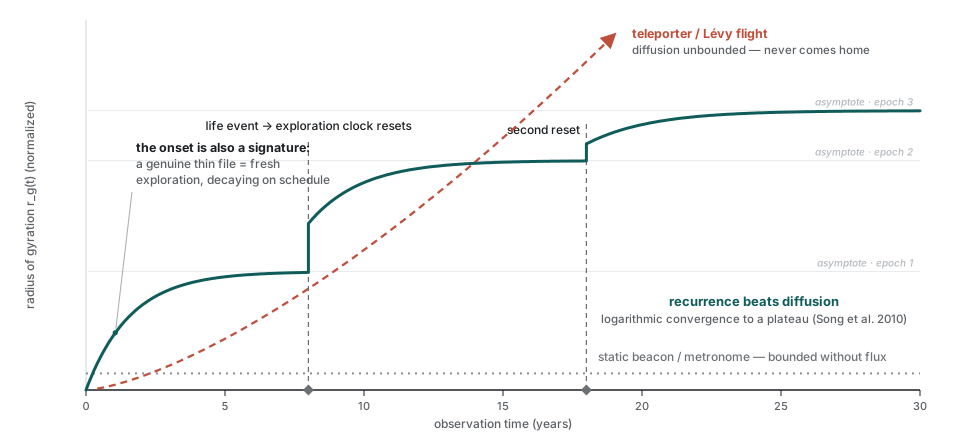
A true Lévy flight has heavy-tailed jump lengths and never converges; its territory keeps growing without bound. A lived trajectory grows, resets after lawful events, and then bends back toward a bounded envelope. That collapse from power-law expansion to logarithmic recurrence is the signal worth preserving.
This is why corroboration should not ask for a street-corner trail. It should ask whether source-side context shows recurrence, renewal, and ordinary constraints — the statistical shape of a life rather than a pile of coordinates.
Synthetic-risk patterns
A synthetic identity can pass surface checks and still lack ordinary coherence. The product proof keeps those patterns explainable without turning them into secret scoring factors.
Thin-file fit
The product proof is built around that distinction. A real borrower can have little bureau-visible history but still show source-side continuity, income, residence, and obligation fit.
Corroboration is not more surveillance. It is a narrower way to decide whether the application story holds together.
FAQ
What corroboration collects, what the static map preview proves, and how thin files differ from fabricated ones.